
22 October 2026
Which party is actually best for your business? Not based on who you usually vote for. Not based on the one the commentators say. The one that comes out ahead when you weigh the 11 policy levers that matter to you, score what each party has really published, and discount for what you think they will (or won’t) deliver. We built the worksheet. Twenty minutes, no sign-up, nobody sees your answers. See who comes out on top:
Most of what decides whether your business has a good year is set in Chicago, Beijing and the Persian Gulf. The rest is on the ballot on 7 November. If you're voting on the colour of a jersey, you're voting on the weather
Parliament doesn’t run the economy - Vote anywaY
On 7 November this country votes, and between now and then every party will tell you it can fix the economy. I want to put a number on how much of that is true, and then tell you what I think you should do about it (but not who I think you should vote for).
I should say where I'm coming from, because on this topic everybody has an angle and most of them hide it. I've had money, I've lost it, and I've made it back. I spend my days with directors who owe Inland Revenue more than they can pay, and a few of my friends are very wealthy individuals. Some of my friends are on the left, some are on the right, and a few of them would struggle to share a lift. I wrote recently that if everyone you know agrees with you, you don't have friends, you have a mirror. Nothing in this piece will tell you who I vote for, and if you finish it thinking you've worked it out, you've guessed.
Here is the claim I want to test. Most New Zealanders, and a surprising number of business owners, believe the government of the day runs the economy. Good years get credited to the Beehive, bad years get blamed on it, and the vote becomes a referendum on whether you felt richer or poorer since the last one. That belief is wrong. Worse, it’s the belief every campaign is built to exploit, because a voter who thinks the Beehive controls the weather will buy a weather forecast from anyone wearing the right colour. Here are the numbers, and what politics actually decides, because that part matters more than people think.
Start with the picture
The chart below is nineteen years of New Zealand's economic growth laid over the growth of the rich world as a whole. The dashed lines are the three elections in that time where the government actually changed hands.
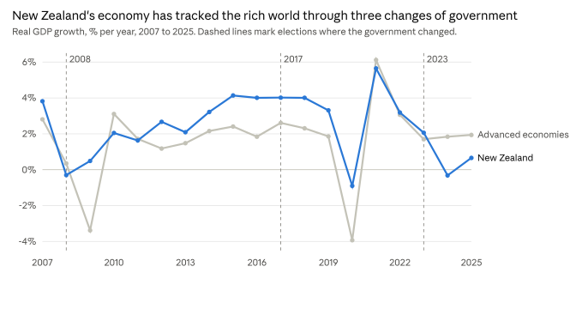
New Zealand: OECD annual real GDP growth via FRED. Advanced economies:
IMF World Economic Outlook via Our World in Data. Elections marked: 2008, 2017, 2023.
Look at what the lines do at the dashed lines, which is nothing. New Zealand fell into recession in 2008 before Lehman Brothers collapsed and before John Key took office, because our housing market and our interest rates had already turned. We grew through the 2010s while the rest of the developed world grew, we shrank in 2020 when the whole planet shrank, we bounced in 2021 when everyone bounced, and we slowed in 2023 and 2024 as the world's central banks lifted rates together. Governments of both colours presided over good years and bad, and the line barely noticed who was in the chair.
That isn't an accident of the data. It’s what a small, open, trading economy looks like. We sell milk powder, meat, logs, fruit and holidays to the rest of the world, and dairy alone is about 28 percent of what we export. China is our largest customer. The price of what we sell is set at auction and on commodity exchanges, not in Wellington. The cost of what we borrow is set by the Reserve Bank, which is independent by law, and the Reserve Bank in turn is pushed around by what the US Federal Reserve does and what global bond investors demand.
If you want a live example, look at your mortgage. Twelve months ago the Reserve Bank was cutting hard, taking the official cash rate down to 2.25 percent to get a stalled recovery moving. Then a war in the Middle East closed the Strait of Hormuz, oil went up, petrol followed, and annual inflation hit 4.1 percent in the June quarter. The Reserve Bank lifted the cash rate in July and again in September, to 2.75 percent, and has said it may go further. Strip fuel out and inflation was 2.9 percent, inside the target band. Nobody in Parliament voted for that war, and nobody in Parliament could have stopped the rate rises that followed. Yet between now and 7 November you'll hear one side claim the rate rises as proof of mismanagement and the other side claim the 1.7 percent annual growth to June as proof of a plan working. Both are taking credit for the weather.
What Parliament doesn’t control, and what it does
Let's be precise about the levers. Parliament doesn’t set interest rates, the exchange rate, the price of milk solids, the price of oil, the growth rate of China, the tariff policy of the United States, or the weather. It sets the Reserve Bank's target and appoints the Governor, and then the law tells it to stay out of the room. It can’t stop a global recession at the border and it can’t manufacture a boom that the rest of the world isn't having. Any politician who tells you they’ll deliver a growth rate is forecasting the weather and asking you to pay them for the forecast.
Before anyone on either side cheers, look at the right-hand end of that chart. In 2024 the rich world grew and we shrank, and in 2025 they grew faster than we did. That gap was mostly ours. The Reserve Bank held rates higher for longer than most of its peers to kill off an inflation problem it had helped cause, and a country with this much mortgage debt feels that faster than most. So domestic settings do matter at the margin, and the margin is where businesses live. Just notice who pulled that lever. It wasn't a minister.
Here’s what Parliament does control, and it’s a long list. It sets every tax rate you pay and every threshold at which you pay it. It decides how much the Crown spends, and on what, and last year that meant a deficit of $8.7 billion, with net debt forecast to peak at about 44 percent of GDP. It writes the employment law you hire and fire under, the Companies Act and insolvency law that decide what happens when a business fails, the consenting rules that decide whether you can build, the immigration settings that decide whether you can find staff, and the funding and management of the health, education and justice systems your family depends on. It decides how hard Inland Revenue pursues arrears and how much patience it shows a business that is trying to trade its way out. It decides whether the courts are resourced to hear your dispute this year or in three years. It decides the road between your factory and the port.
None of those things show up as a wiggle in the growth line within a single term, which is why they get crowded out by the economy argument on the campaign trail. All of them show up in your life. The growth line is the weather. The lever list is the house you live in, and the house is the thing you're actually voting on.
The jersey is not an argument
Once you accept that the economy is mostly weather, the left-right argument loses most of its heat, because the left-right argument is mostly an argument about who should get credit for the weather. What's left is a set of practical questions about the house, and those questions don't sort neatly by colour.
I've watched this up close for 25 years. The wealthy people I know aren’t all on the right and the people doing it hard aren’t all on the left. The business owner struggling with an IRD arrangement will sometimes vote for the party promising tougher enforcement, because he believes in paying his way and hates the competitors who don't. The rich lister will sometimes vote for the party promising higher taxes, because she worked out long ago that a country where the hospital works and the roads are sealed is a better place to be rich in. Neither of them is confused. They’ve both done something most voters don't, which is to ask what a policy does rather than which tribe it belongs to.
Now for the uncomfortable part. If you’ve voted the same colour your whole adult life and couldn’t, right now, name three policies in that party's current manifesto, you’re not a voter. You’re a fan. It makes no difference whether the jersey is blue, red, green, yellow or black. Fans don't read the policy, fans don't check the record, fans cheer when their side scores and boo when the other side does, and fans are the cheapest thing in politics to buy. Every attack ad in the next three weeks is aimed at you, and it’s aimed at you because it works. I spent eleven years in court against people whose trade was manufacturing exactly that feeling, and I can tell you the product works best on people who already know whose side they're on. The dirty politics Nicky Hager has spent a career documenting only pays because tribal voters are cheap to move and expensive to lose. Nobody spends money on the voter who reads.
There is a stranger thing the jersey does, and I see it every election. People who like each other stop. A mate you've fished with for twenty years mentions who he's voting for and something in your face changes. A client you've trusted with your business for a decade turns out to be on the other side and you find yourself re-reading their emails for evidence. Think about how odd that is. Who the person across the table votes for has close to no bearing on how they treat you, whether they pay their bills, whether they'd help you move house or turn up to your father's funeral. Those are the things you actually know about them, and you know them from years of evidence. Yet a single word about a ballot paper can outweigh the lot. I have friends who disagree with each other about nearly everything the government does and still would not hesitate to pull each other out of a ditch. They managed that by deciding, early on, that a vote is a decision and not a diagnosis. Hating someone for their politics is hating them for the weather forecast they believe. It’s a weird thing to lose a friend over, and it’s a weirder thing to lose a customer over.
The same thing happens with the politicians themselves, and it has stopped being dislike and become something closer to hatred. Say the names Jacinda Ardern or Chloe Swarbrick in certain rooms and watch the temperature change. Say John Key, David Seymour or Winston Peters in other rooms and watch the same thing. These are people who’ve likely never met the person doing the hating, never dealt with them, and had almost no direct bearing on their lives. The hatred is tribal, and it’s identical on both sides, right down to the vocabulary.
The one I hear most is that Jacinda cost someone a fortune. I understand the feeling, I lost money in those years too. But look at the chart again. In 2020 the economies of the rich world shrank by nearly 4 percent and ours shrank by less than 1. There was a global pandemic. Every government on earth borrowed, spent, shut things and reopened them, and every economy on earth paid for it afterwards in inflation and interest rates. You can argue about the lockdowns, the spending and the border, and plenty of serious people do. What you can't argue is that a Prime Minister in Wellington set out to send the world broke, or that your business would have sailed through 2020 and 2022 untouched under a different jersey. Reverse the colours and it's the same story. The people who blame John Key for what the global financial crisis did to them in 2009 are making the identical mistake, and so will the people who blame or credit whoever is in charge for what the oil price does next year. Hating a politician for the weather is still hating the weather. It just has a face on it. And whatever the scorecard says about any of them, there’s still room in the world to be kind. Delivery is a measure of a government. It’s not a measure of a person.
So take the jersey off. Not because both sides are the same, they aren't, but because the differences that matter are in the lever list, not the slogans, and you can't read the lever list through a jersey. If that stings, good. It should sting a lot less than finding out in three years that you voted for a feeling.
How to decide
Here is the method I'd use, and it's the same one I use on a business that wants me to tell it whether a plan is real.
First, cross out every promise that depends on the weather. If the pitch is a growth rate, a surplus by a certain year, cheaper mortgages or a stronger dollar, it is a forecast dressed as a commitment, and the person making it has no more control over it than you do. What's left after the crossing out is the real manifesto, and for most parties it is shorter than you'd expect.
Second, for each promise that survives, ask three questions. What lever does it pull? Who pays, and when? And what does it do, in practice, to the lives of the people you care about, which can mean your family, your staff, your customers, the bloke who does your books, or people you'll never meet whose kids are in the same hospital system as yours. That last question is where your values come in, and they should. This isn't an argument for voting on self-interest alone. It is an argument for voting on consequences rather than feelings. Because that is a lot of work to do from a standing start, we've done the research part for you. Alongside this article is an interactive worksheet that sets out what each of the six parliamentary parties has published on eleven levers that Parliament actually controls: tax, Crown spending, employment law, insolvency and the Companies Act, consenting, immigration, health, education, justice and the courts, IRD enforcement and roads. Every entry is in the party's own words or a flat paraphrase, with a source, and where we couldn't verify something it says so. You weight each lever for how much it matters to you, score each party on each lever, and the site does the arithmetic. The scores are yours, not ours, and we've deliberately left every one of them blank.
Third, discount for competence. A policy is only as good as the people who have to deliver it, and the delivery record of a party is public. Promises that have been made before and not kept should be priced accordingly, whichever side made them. If you'd never hire a manager on the strength of a job interview alone, don't hire a government that way. The site also carries a reference check, the government delivery scorecard. It takes the headline promises of the last three governments, Key, Ardern and Luxon, and sets each one against what was actually delivered, rated delivered, partly delivered or dropped, weighted by how much it mattered, with a source for the promise and a source for the outcome. Promises that depended on the weather, a surplus by a given year, a growth rate, a poverty target, are listed but not scored, for the reasons above. The same method is applied to all three governments, and the results will annoy at least one tribe, which I take as a sign the method is fair. If you can show with a source that any entry is wrong, email me and the next version will correct it and say so.
Fourth, and this is the one most people skip, decide how much of your life this deserves. Voting matters. Fighting about it on social media for three weeks does not. Once you've done the work above, the decision will probably take you an evening, and the right amount of effort to spend on an argument with your brother-in-law afterwards is none.
Then vote. Enrolment closes on Sunday 25 October, advance voting opens on Monday 26 October, and election day is Saturday 7 November. If the decision is close, that's fine. Close decisions made on the lever list are better for the country than confident ones made on the jersey.
What we want from 7 November
I'll finish with what this election means for us, because it's the same thing it means for most of the businesses we work with. We don't have a dog in the fight. Our clients come from every part of the political spectrum and so does our referral network, and the day we're seen as a firm of one colour is the day half of them stop calling.
What we want is for it to be over. An election is a three-month pause button. Directors who should be restructuring now are waiting to see what happens to tax settings. Lenders who should be making decisions are waiting to see who the minister is. Inland Revenue, which has had the brakes off for two years and accounts for a large share of the winding-up applications in this country, will keep working through the campaign, and the businesses it is chasing do not get a pause. The cost of waiting is real, it is paid by the people who can least afford it, and most of what they are waiting to find out won't change the fundamentals of their situation anyway. A business with a cashflow problem in October has the same problem in November under either government.
So our advice to clients between now and the election is the same as our advice to voters. Work out what is actually within your control, deal with that now, and stop waiting for Wellington to fix the weather. On 8 November we'll know who's in charge of the house. The weather will carry on regardless, and so will we.
The party policies worksheet and government delivery scorecard are free to use and when you're done you can copy your result to keep or share. The research was compiled on 13 October and parties are still releasing policy, so check the party's own page before you rely on an entry, and if you find a mistake, tell me. The point of this exercise isn't that my research is perfect. It's that an evening with a worksheet and a reference check is a better way to choose a government than the colour of a jersey, and you'll know more about what you're voting for than most of the people shouting at you about it.